

This buying guide for Solar POE Switches covers the essential features to evaluate before purchasing, drawing from the expertise of Shenzhen Ficotek Photonics Co., Ltd. (FICOTEK). Key features include industrial-grade temperature resistance (-40°C to 85°C), robust lightning and surge protection (up to 6kV on ports), and comprehensive network management capabilities such as VLAN, QoS, RSTP, ERPS, SNMP, PoE control, and link aggregation—all while maintaining low power consumption. The guide emphasizes the importance of PoE standards (802.3af/at/bt) and total power budget matching solar inputs with MPPT charge controllers and battery management for efficient off-grid operation. Customization and after-sales support are highlighted through FICOTEK’s factory-backed OEM/ODM services and their “one-year replacement, three-year warranty, lifetime technical support” policy. Certifications, patents, and applications in industries like petroleum, energy storage, high-speed rail, wind power, and security are discussed. The summary concludes that selecting a solar POE switch requires balancing technical specs with reliability and customization, with FICOTEK offering a complete solution from optical components to final product.
In the era of renewable energy and remote monitoring, solar-powered Power over Ethernet (POE) switches have become essential for powering and connecting devices like IP cameras, wireless access points, and sensors in off-grid or outdoor locations. Unlike traditional switches, solar POE switches integrate photovoltaic charging and battery backup, ensuring uninterrupted operation even in harsh conditions. However, selecting the right solar POE switch requires careful evaluation of several critical features. This guide, based on insights from industry leaders like Shenzhen Ficotek Photonics Co., Ltd. (FICOTEK), highlights the key parameters you must check to ensure performance, reliability, and longevity.
1. Industrial-Grade Temperature Resistance
Solar installations are often exposed to extreme temperatures—from scorching desert heat to freezing mountain cold. A solar POE switch must withstand these variations without failure. FICOTEK’s products feature industrial-grade temperature resistance, typically rated for -40°C to 85°C. This ensures stable operation in environments where consumer-grade switches would fail. When buying, look for switches that explicitly state an extended temperature range and are tested for thermal cycling. The housing should be rugged and fanless to avoid mechanical failures from dust or condensation.
undefined
2. Lightning and Surge Protection
Outdoor solar installations are vulnerable to lightning strikes and power surges, which can damage electronics. Effective lightning protection includes built-in surge arresters on Ethernet ports and power inputs. FICOTEK incorporates outdoor lightning protection capabilities in their switches, often meeting standards like IEC 61000-4-5. Check for specifications such as 6kV surge protection on PoE ports and 10kV on AC/DC inputs. Also, ensure the switch has proper grounding terminals. Without robust protection, a single storm could render your network inoperable.
3. Network Management and Features
A solar POE switch should offer lightweight network management to optimize performance and security. Essential features include:
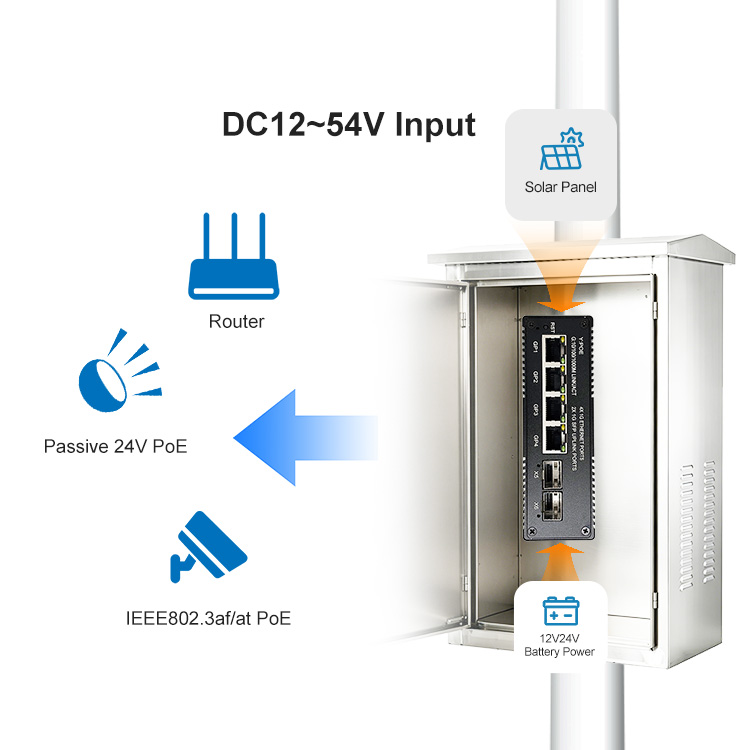
- VLAN (Virtual LAN): Segregate traffic for different applications (e.g., cameras vs. sensors) to improve security and reduce congestion.
- QoS (Quality of Service): Prioritize critical data like video streams or real-time controls over less urgent traffic.
- RSTP (Rapid Spanning Tree Protocol): Prevent network loops and provide redundancy in case of link failures.
- ERPS (Ethernet Ring Protection Switching): Offer sub-50ms recovery in ring topologies, vital for high-availability systems.
- SNMP (Simple Network Management Protocol): Enable remote monitoring and configuration via network management software.
- PoE Control: Manage power allocation per port, schedule power cycles, or remotely disable unused ports to save energy.
- Link Aggregation: Combine multiple ports for higher bandwidth and redundancy.
FICOTEK’s switches integrate these features with low power consumption, making them ideal for solar-powered deployments where every watt counts.
4. Power over Ethernet (PoE) Capability
The core function of a PoE switch is to deliver power and data over a single cable. Consider the following:
- PoE Standard: IEEE 802.3af (15.4W per port), 802.3at (30W), or 802.3bt (60-90W). For modern devices like PTZ cameras or high-power access points, 802.3bt is recommended.
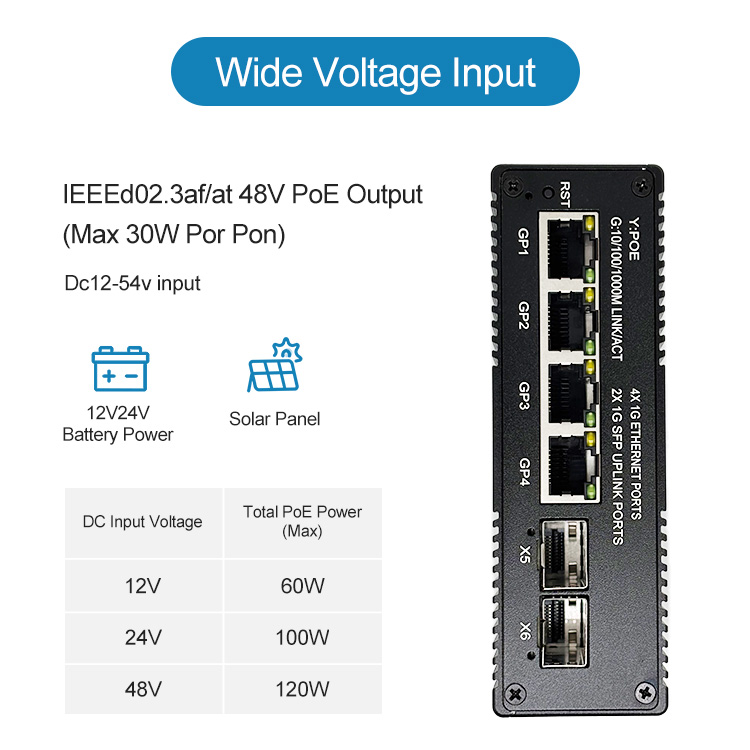
- Total Power Budget: The sum of power the switch can supply to all PoE ports. A solar-powered switch must align with the solar panel and battery capacity.
- PoE Power Management: Features like per-port power limit, priority, and scheduling help optimize usage of limited solar energy.
FICOTEK offers switches with flexible PoE configurations, including models that support up to 240W total budget, suitable for multiple high-power devices.
5. Solar Input and Battery Management
A true solar PoE switch includes a charge controller and battery interface. Key aspects:
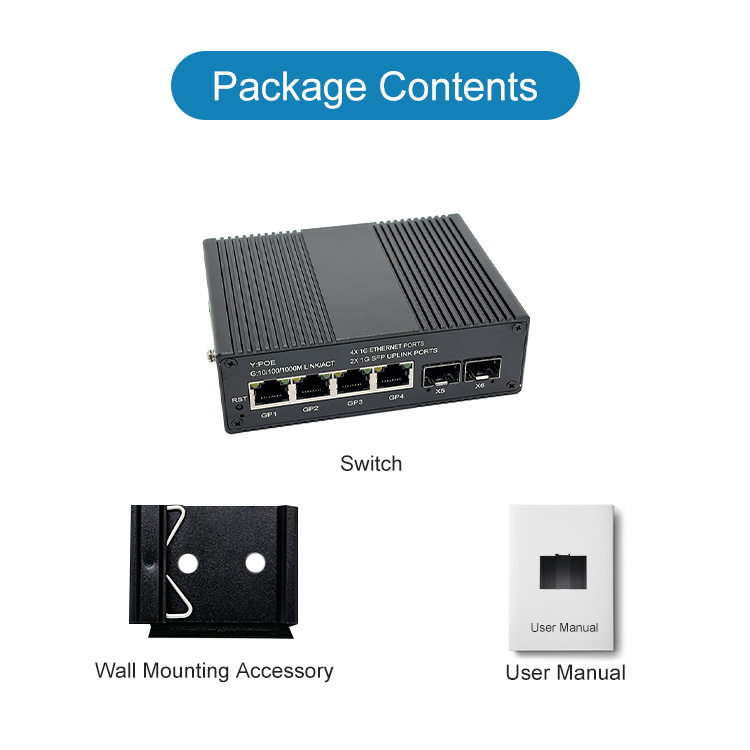
- MPPT (Maximum Power Point Tracking): Maximizes energy harvest from solar panels, especially in partial shade or varying light.
- Battery Compatibility: Supports lead-acid, lithium-ion, or LiFePO4 batteries. Check voltage (12V/24V) and charging algorithm.
- Battery Protection: Overcharge, deep discharge, short circuit, and reverse polarity protection to extend battery life.
- Low Power Consumption: The switch itself should consume minimal power (e.g., <10W idle) to leave more for connected devices.
FICOTEK’s switches are designed with low power consumption, and their integrated power management ensures efficient use of solar energy.
6. Customization and After-Sales Support
Every solar project has unique requirements. FICOTEK, with its own factory and complete R&D capabilities across the entire optical communication chain (from optical components to TOSA/ROSA/BOSA, optical modules, media converters, and industrial switches), can provide customized products with independent intellectual property rights. They offer OEM and ODM services, tailoring hardware, firmware, and packaging to customer needs. Their after-sales policy includes “one-year replacement, three-year warranty, and lifetime technical support,” a testament to their confidence in reliability. When choosing a supplier, consider their ability to customize and provide long-term support.
7. Certifications and Patents
Reliable switches undergo rigorous testing. FICOTEK holds invention patents and utility model patents. Products are subjected to reliability verification before market launch. Look for certifications such as CE, FCC, RoHS, and industry-specific ones like IEC 61850 for substations or EN 50155 for rolling stock. For outdoor solar, IP40 or IP30 enclosure rating is common, but consider IP65 if directly exposed to rain.
8. Applications Across Industries
Solar PoE switches are used in diverse fields: petroleum and gas (remote wellhead monitoring), energy storage (battery farm surveillance), high-speed rail (wayside cameras), wind power generation (turbine monitoring), and security (perimeter detection). FICOTEK’s products serve these sectors, with features like wide temperature range and vibration resistance. When selecting, ensure the switch meets the specific environmental and regulatory demands of your industry.
Conclusion
Choosing the right solar POE switch involves balancing technical specifications, reliability, and support. Key features to check: industrial temperature range, lightning protection, advanced network management (VLAN, QoS, RSTP, ERPS, SNMP, PoE control, link aggregation), PoE power capacity, solar charge controller and battery management, customizability, certifications, and after-sales service. Companies like FICOTEK, with their comprehensive in-house R&D, manufacturing, and patent portfolio, offer tailored solutions backed by strong warranties. By evaluating these factors, you can deploy a robust, future-proof network that harnesses solar energy efficiently.
About the Author: This guide is written based on industry knowledge and insights from Shenzhen Ficotek Photonics Co., Ltd., a leader in optical communication and industrial networking solutions.